LimeLyte® Intelligent Tax

Tax intelligence that applies to your business.

Most tax AI helps people search and summarise legislation. LimeLyte® Intelligent Tax goes further. It captures and manages how your organisation interprets that legislation, including approved tax positions, local requirements, business-specific decisions, exceptions and controls.

The governing thread
  1. Source
  2. Interpretation
  3. Requirement
  4. Control
  5. Business decision

The challenge

Searching legislation is only the beginning.

The question is how the law applies to your organisation, which position has been approved, and what that means for a system, process, contract or control.

Tax information is a starting point

A general explanation of legislation cannot, on its own, represent the decisions your organisation has made.

  • Approved interpretation and exceptions
  • Countries, entities and transactions in scope
  • Requirements for systems, processes and evidence

The difference

Not just what the law says. How your business interprets, applies and controls it.

Both approaches can help people find tax information. The difference is the approved organisational context used to turn information into a decision.

Legislation-search AI

Finds and summarises external tax content. An answer may remain general when the organisation’s position, systems and controls are not represented.

LimeLyte® Intelligent Tax

Connects the external source to approved interpretation, global and local requirements, controls and the business decision under review.

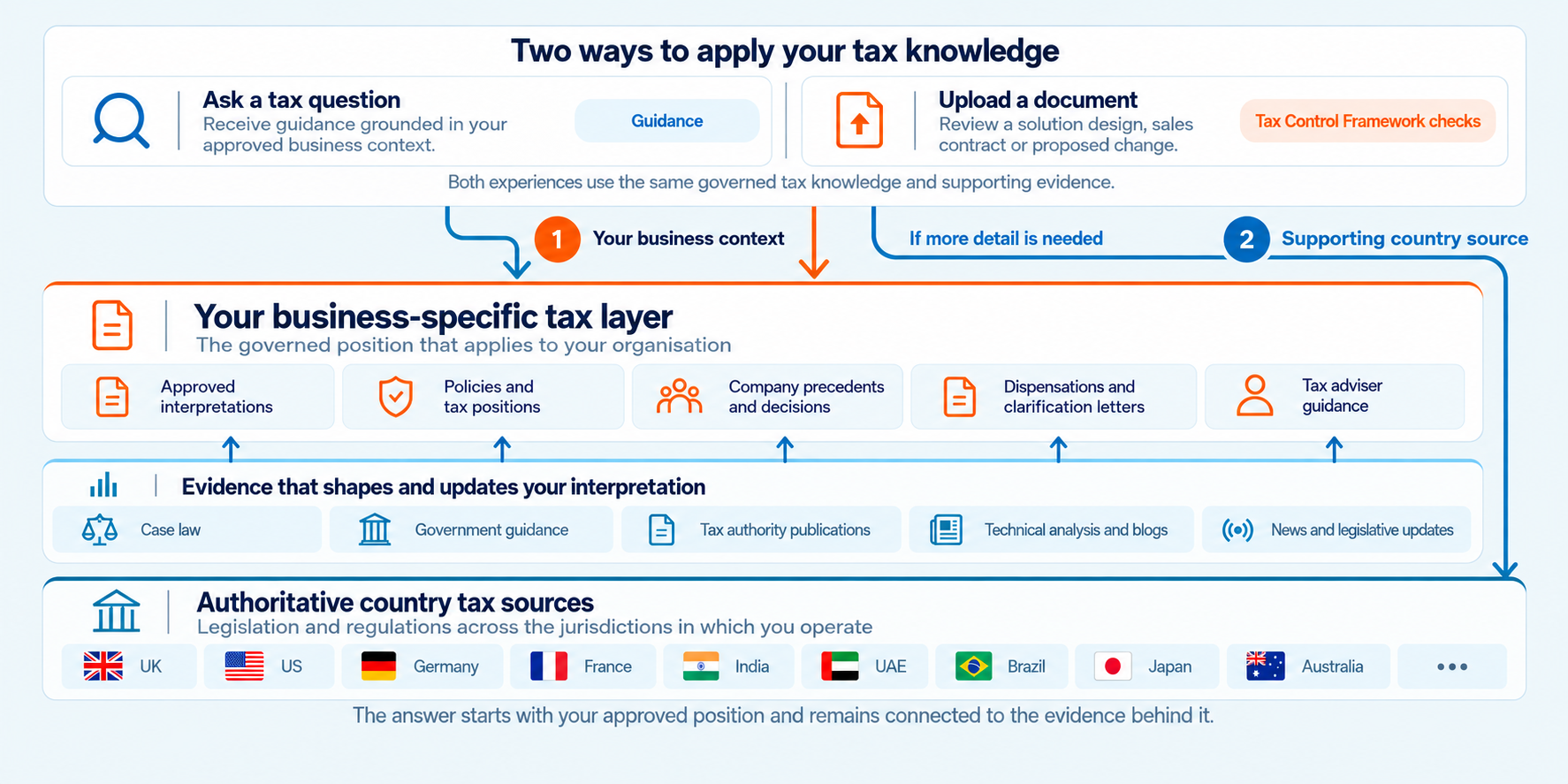
Two ways to use tax knowledge: ask a tax question for guidance or upload a document for Tax Control Framework checks. Both use approved business-specific tax positions, supporting evidence and authoritative country tax sources.
View the diagram at full size

Two ways to apply the same governed tax knowledge.

Ask for guidance in business context, or assess what a proposed document or design would mean for tax.

Ask the AI

Your approved business position comes first. The AI looks for your organisation’s interpretation and relevant global or local requirements, while checking the legislation and guidance that support them. The answer explains how your business has decided to apply the rule, with the underlying sources visible. If the position and current source appear to differ, it flags the point for Tax review.

Upload a document or design decision

Submit a sales contract, requirements document, high-level design or solution design. Its content can be cross-referenced against structured Tax Control Framework checks, the global tax design template and applicable local requirements to identify potential gaps, conflicts and control needs.

In an implementation: architectural design decisions can be assessed as they are made, helping the Tax team address risks and missing requirements before a design is approved.

Explore change assessment

The proposition

From external knowledge to business action.

LimeLyte® Intelligent Tax connects sources, decisions and requirements so relevant teams can work from the same approved context.

01

Understand the source

Bring legislation, regulations and official guidance into a governed knowledge base. Identify the jurisdiction, effective date and source behind the question or proposed decision.

02

Record the business position

Capture approved tax positions, global design choices and local exceptions. Record where they apply, who owns the position and how the organisation has interpreted the source.

03

Define what is required

Turn approved positions into structured requirements for contracts, systems, processes and controls. Specify the conditions, responsible owner, evidence and points requiring Tax review.

04

Assess the business decision

Run a repeatable check before approving a sales contract, IT purchase or other relevant change. Identify gaps, record evidence and route unresolved matters for specialist review.

Company policy can require this assessment at defined decision points. When connected to an approval workflow, completion and resolution of identified issues can be enforced before the decision proceeds.
Explore change impact assessment

Global and local

Knowledge applied in context.

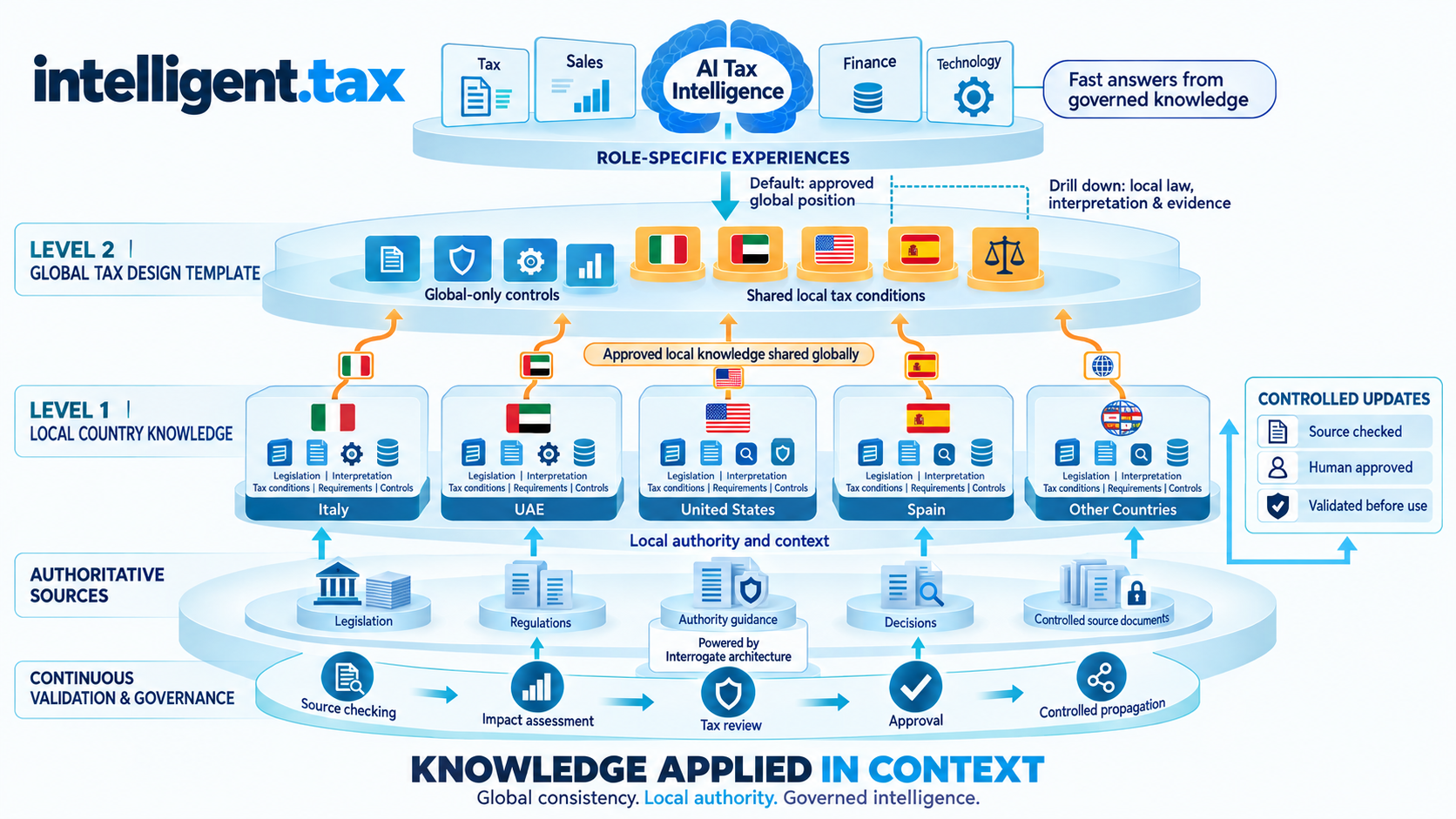
An organisation-wide tax design supports consistency. Country knowledge supplies the detail and exceptions that a global answer alone may miss.

Intelligent Tax knowledge model: authoritative sources feed local country knowledge, which informs a global tax design template. Role-specific AI experiences use the approved global position and can drill down to local law and evidence. Source checking, impact assessment, tax review and approval govern updates.
View the diagram at full size
Explore the global and local model

The control connection

Interpretation becomes operational control.

Structured tax requirements define what should happen, where conditions apply, who is responsible and what evidence is needed.

From legislation, to organisational interpretation, to operational control.

Explore the Tax Control Framework

Change assurance

Assess a proposal before it becomes an expensive gap.

Use approved tax knowledge as a baseline for reviewing applications, configurations, integrations, processes, contracts and designs.

See the implications earlier

A review can surface conflicts with approved positions, missing information, weak controls and local requirements that need attention.

  • Procurement and vendor selection
  • Architecture and functional design
  • Testing, release and go-live decisions

Why Innovate Tax

Tax technology and business design belong together.

Innovate Tax works at the intersection of tax, enterprise systems and transformation. LimeLyte® Intelligent Tax reflects that focus on turning tax decisions into requirements that can be applied in real business change.

About Innovate Tax

Next step

See how it applies to your business

Discuss your tax knowledge, control and change priorities with Innovate Tax.

Discuss your requirements